

Aşure
Metin Bobaroğlu
HARMONY IS THE DEEPEST CULTURAL EXPERIENCE THAT ANATOLIA HAS OFFERED THE WORLD.
Anatolian lands are not a place where cultures pass through, but a ground for harmony. Beliefs, languages, and traditions that appear to be different on the surface have coexisted here without eliminating one another. This coexistence is neither a synthesis nor an amalgamation; each has preserved its own identity while learning to listen to the other and exist together.
Aşure is the very symbol of this cultural structure. Different flavours, colours and textures come together; each retains its own character, but all converge in a common taste. This is the expression of the true dialogue hidden in Anatolia’s ancient wisdom.
While the modern world’s understanding of civilisation is based on progress through destruction and erasing the past, Anatolia is built on coexistence, multiculturalism and their genuine relationships with one another.
Perhaps what we need most today is this: to coexist not by erasing, but by preserving.
Metin Bobaroğlu and Ayşe Acar, guided by Alevi-Bektaşi sayings, reignite the smouldering fire beneath the deeply buried discourse through their conversations on Anatolia, the crossroads of ancient wisdom.
Language: Turkish

Listen from Ney* / Dinle Ney’den
Metin Bobaroğlu
Sufism begins with individual wisdom and is a work of freedom.
Sufism is a kind of inner experience, but it also has a side related to wisdom and reason. In Sufism, knowledge is not only based on logical inference, but also on intuition and discovery.
It is the way to make sense of oneself, man, nature and the universe, starting from one’s own source. While defining itself, Sufism addresses man directly, the human heart and places man at the center. The target in Sufism is the Perfect Man. When man meets God, he becomes the Perfect Man. The Perfect Man tells the way for each man to seek his own perfection and is actually the secret of man, who is a whole universe. Everyone must walk this path on his own journey.
This journey that man makes from humanity to divinity in his own self takes place within the boundaries of the concept of the Perfect Man. It is said that truth is three letters and five dots. Ayn-Sin-Kaf is three letters, Kaf has two dots, with five dots it becomes Love.
* Ney: reed flute
Language: Turkish
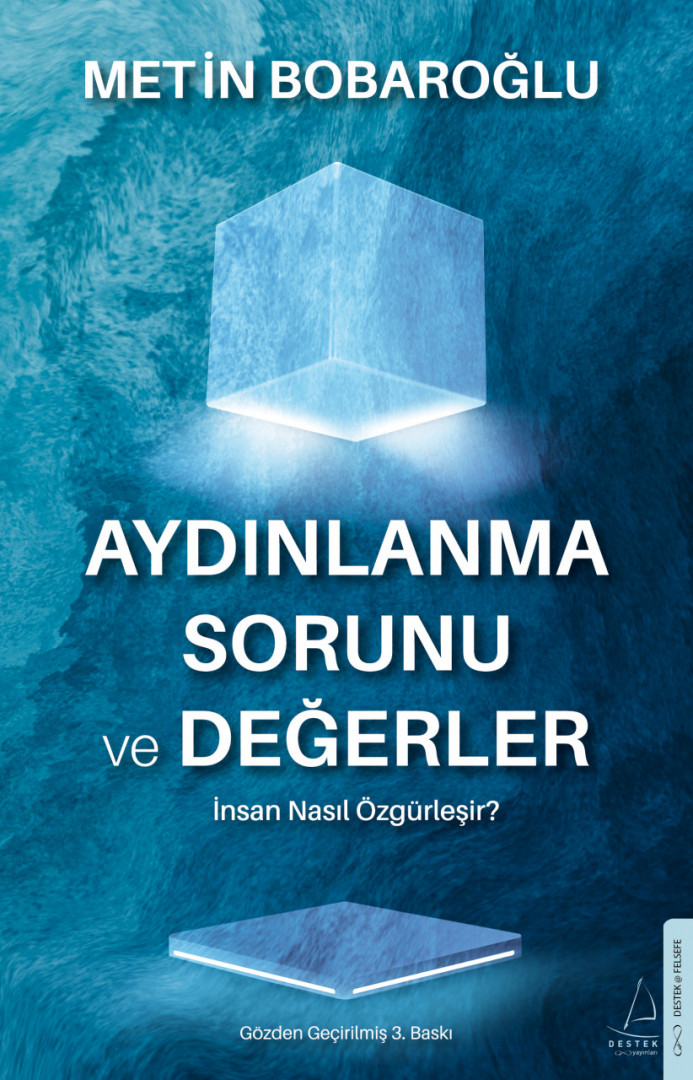
The Problem of Enlightenment and Values / Aydınlanma Sorunu ve Değerler
Metin Bobaroğlu
“Man is born three times. The first birth is surrounded by the environment of culture. The second birth is to be born into education; man is shaped by pedagogical, psychological and scientific methods. The third birth is man’s birth from himself, which is man’s shaping his own life with his own free will.
A man born from himself is a revolutionary. A revolutionary man is a man who sees the conditions that will carry the historical process to a qualitative leap and reveals it as an independent character in himself. People born from themselves are the subjects of history. They do not exist only for their own individual lives, but most of the time, they disregard their own individual lives and attach themselves to a human ideal with all their being and internalize it as a passion in themselves.”
Thinker and writer Metin Bobaroğlu addresses enlightenment as a problem in his book The Problem of Enlightenment and Values. He says that every person in the enlightenment process creates his intellectual, psychic, social and spiritual life depending on the values he chooses, and that the social and individual spirit is produced in this way. He emphasizes that the foundation that creates civilization is concepts that turn into values.
Language: Turkish

Esoteric Tradition / Batıni Gelenek
Metin Bobaroğlu
WE ARE THE PEOPLE OF ANATOLIA, EMBRACING NEARLY FORTY DIFFERENT CULTURES.
ANATOLIA IS A CROSSROADS WHERE EASTERN AND WESTERN CIVILIZATIONS MEET.
The Western narrative confines disciplines of thought to its own interpretations, asserting that learning in today’s world can only derive from these perspectives, while claiming that other nations cannot develop their own disciplines from within their own structures.
What you will read in this book serves as a critique of such barriers imposed by Western thought disciplines.
Batıni Gelenek (Esoteric Tradition) takes a conceptual journey, tracing back from the starting point defined by Western thought—Ancient Greek civilization. It begins with the “enlightenment” practices of the esoteric/hermetic teachings in Ancient Egypt. From there, it ventures into the Eastern world, reaching Tibet, India, China, and Iran, delving into temple interiors. It travels into the history of the Turks, leading the reader on a captivating journey back to Anatolia. With a sense of historical awareness and cultural identity, it underscores the honor of being a universal human being.
Language: Turkish

Symbolic Thinking / Simgesel Düşünme
Metin Bobaroğlu
“Symbolic thinking is a way of thinking that transcends reality and enables the search for the ideal beyond the existing reality. While the ideal is limited by concepts, the symbol offers new possibilities to overcome these limits. The symbol is an umbilical cord; it functions to develop understanding rather than understanding, and serves the processes of discovery and invention rather than knowing. Every consciousness is a seeker of meaning in its relationship with the symbol.”
In Symbolic Thinking, compiled from his writings and speeches spanning over fifteen years, Metin Bobaroğlu emphasizes that symbols are attributed a meaning in proportion to the person’s cultural structure, life experience, knowledge accumulation, level of perception and spiritual tendencies, and says that symbolic language can also be defined as the abundance of a tradition that has developed and deepened throughout history.
Bobaroğlu, drawing attention to the fact that the symbol is related to the unconscious, dreams and myths as much as it is to the conscious, establishes its necessary relationship with the concepts of ritual and temple within ancient wisdom and takes the reader on an unconventional journey of thought.
Language: Turkish